
Few games in recent memory have carved as deep an impression as Ninja Theory’s “Hellblade: Senua’s Sacrifice” did back in 2017. With its haunting portrayal of psychosis and Norse mythology, it set a new standard for narrative-driven experiences. Now, nearly a decade later, “Senua’s Saga: Hellblade II” arrives, promising not only to expand Senua’s journey but to redefine the boundaries of interactive storytelling in an era where technology and artistry intermingle more seamlessly than ever. In 2026, with narrative adventures sitting at the forefront of mainstream gaming, Hellblade II stands as both a showcase for next-gen hardware and a bold exploration of the human psyche.
Senua’s new journey is as much about confronting the darkness within as it is about facing the monsters that lurk in the shadowy corners of Iceland’s mythic landscape. Ninja Theory once again places the player directly inside Senua’s fractured mind, blending psychological horror, meditative puzzles, and visceral combat into a seamless, deeply personal odyssey. This is not just a sequel—it’s a statement of intent, a testament to how far the medium has come in treating mental health with nuance and respect.
As expectations for narrative fidelity and technical prowess have soared in this generation, Hellblade II does not merely keep pace—it strives to set new benchmarks. From the moment the game opens, it is evident that Ninja Theory has poured its resources into every frame, every whisper, every tremor of Senua’s journey. The result is a title that is both harrowing and beautiful, intimately familiar yet daring in its ambition.
Gameplay: Struggling in the Shadows
The essence of Hellblade II’s gameplay remains rooted in the immersive blend of exploration, puzzle-solving, and taut, cinematic combat that defined its predecessor. However, this time around, every element feels more refined and purposeful. The game never inundates players with overwhelming mechanics or extraneous systems; instead, it focuses on drawing the player deeper into Senua’s perspective, making every action feel meaningful and fraught with consequence.
Combat sequences are more intense and visceral, often unfolding in claustrophobic environments that echo Senua’s turbulent inner world. The physicality of each encounter is palpable, with precise timing and careful observation rewarded over button-mashing. Meanwhile, environmental puzzles are woven organically into the world, challenging players to see past illusions and perceive reality through Senua’s fractured lens.
What truly sets Hellblade II apart from other titles in the narrative adventure genre is its unwavering commitment to immersion. There are no intrusive HUD elements, no waypoints cluttering the screen—just the raw, unfiltered experience of Senua’s struggle. This approach demands engagement and attention, rewarding players with a level of emotional investment rarely achieved in modern games.
Core Mechanics
At its heart, Hellblade II is an exercise in empathy, and its mechanics reflect this focus. The game’s core systems—combat, exploration, and puzzle-solving—are tightly interwoven, each serving both gameplay and narrative purposes. Combat is deliberately paced, requiring players to read enemy movements and time dodges and counters with precision. Every sword swing carries weight, every wound is felt, reinforcing the sense of vulnerability that defines Senua’s character.
Puzzle sequences, meanwhile, are less about traditional logic and more about perception. Players must manipulate the environment, align symbols, and use light and shadow to reveal hidden paths. These mechanics are not only visually impressive but thematically resonant, echoing Senua’s battle to distinguish reality from hallucination.
The game also introduces subtle survival elements, such as managing Senua’s stamina and mental state during prolonged encounters. These additions deepen the connection between player and protagonist, as moments of panic or exhaustion are mirrored in both gameplay and narrative feedback.
New Additions and Features
Ninja Theory has clearly learned from the feedback on the original Hellblade, implementing a host of new features that enhance the player experience without compromising the game’s core identity. Among the most notable is the expanded use of binaural audio, which envelops players in a dizzying soundscape that shifts and morphs based on Senua’s psychological state. This is not just a technical flourish—it’s a storytelling device, and it’s more sophisticated than ever before.
The sequel also introduces a dynamic weather and day-night system, which not only elevates the visual spectacle but subtly affects gameplay and mood. Certain puzzles and narrative sequences are influenced by these environmental changes, adding both replay value and a sense of unpredictability to the journey.
Another significant addition is a more nuanced approach to Senua’s mental health. While the first game was lauded for its sensitive portrayal of psychosis, Hellblade II expands this by offering branching narrative moments where player choices—subtle and often ambiguous—can influence Senua’s perception of the world and her relationships with other characters. This interactivity lends the experience a sense of agency without detracting from the tightly scripted narrative.
Single-Player Campaign
Hellblade II is an unapologetically single-player experience, and its campaign is a masterclass in pacing and emotional storytelling. The game unfolds over roughly 10 to 12 hours, with little in the way of filler or repetitive content. Each chapter is carefully crafted to evoke a range of emotions—fear, hope, despair, and ultimately, catharsis. The narrative structure is lean but impactful, eschewing the open-world bloat that has come to dominate the genre in recent years.
The campaign is meticulously structured, with peaks of high-intensity combat and moments of quiet introspection. Senua’s journey is punctuated by hallucinatory sequences that blur the line between reality and delusion, keeping the player constantly off-balance and invested in her fate. Thanks to excellent voice acting and motion capture, every cutscene feels intimate and immediate, drawing the player ever deeper into Senua’s world.
Replay value is bolstered by the inclusion of hidden lore stones and branching narrative elements, but make no mistake: Hellblade II is best experienced as a singular, uninterrupted journey. The campaign’s emotional impact is cumulative, building relentlessly toward a finale that is both devastating and redemptive.
Story and Setting
The narrative thrust of Hellblade II remains as compelling as ever. Senua, no longer the isolated outcast of the first game, finds herself drawn into a wider conflict as she journeys across a mythic, war-torn Iceland. Themes of trauma, grief, and the search for meaning are woven through every interaction, every vision, every battle. The script is more ambitious and layered than its predecessor, enriched by a supporting cast that brings new perspectives and complexity to Senua’s world.
While Norse mythology still serves as the backdrop, Hellblade II delves deeper into its source material, drawing on lesser-known legends and folklore to craft a setting that feels both ancient and immediate. The game’s world is a character in itself, shaped by Senua’s perceptions and haunted by her memories. This approach gives the narrative a dreamlike, almost surreal quality, where the boundaries between inner and outer reality are constantly shifting.
Senua’s personal arc is handled with remarkable sensitivity. Her struggles with psychosis are neither sensationalized nor minimized; instead, they are depicted as a fundamental part of her experience, informing her relationships and her choices. The result is a story that is both epic in scope and deeply personal, resonating long after the credits roll.
Level Design
Level design in Hellblade II is a triumph of atmosphere and intent. Environments range from desolate, wind-swept plains to claustrophobic, labyrinthine ruins, each meticulously crafted to reflect Senua’s psychological state. The transition between the real and the unreal is seamless, with visual and audio cues subtly guiding the player through the shifting landscape of Senua’s mind.
Puzzle elements are expertly integrated into the environment, rarely feeling forced or out of place. Instead of traditional “gamey” obstacles, players encounter organic challenges that require observation, intuition, and a willingness to see things from Senua’s unique perspective. This approach not only supports the narrative but also encourages a more thoughtful, immersive style of play.
Exploration is generally linear but punctuated by occasional branching paths and hidden secrets. The world feels alive and dangerous, with each area telling its own story through environmental detail and ambient storytelling. This design philosophy ensures that even the quietest moments are laden with tension and meaning.
Multiplayer and Online Experience
True to its narrative-driven roots, Hellblade II does not feature traditional multiplayer modes. There is no co-op or competitive play, and the absence of online features is a deliberate choice that reinforces the game’s intensely personal focus. In an age where many big-budget releases chase persistent online engagement, Hellblade II stands apart as a solitary, meditative experience.
That said, Ninja Theory has embraced some contemporary trends by including optional online integration for sharing in-game photo mode creations and narrative choices. Players can compare their journey decisions with others, fostering a sense of community discussion without compromising the sanctity of the single-player narrative. Leaderboards for certain puzzle sequences and combat trials offer a touch of asynchronous competition for those who desire it, but these features are strictly ancillary.
Ultimately, Hellblade II’s online elements are unobtrusive and entirely optional—an acknowledgment of modern gaming habits without diluting the game’s core identity.
Graphics and Visuals
On a technical level, Hellblade II is nothing short of breathtaking. Leveraging the full might of current-generation consoles and high-end PCs, the game sets a new gold standard for facial animation, environmental detail, and lighting. Senua’s expressions are rendered with uncanny fidelity, capturing every flicker of doubt, rage, and hope. The result is a protagonist who feels more alive and relatable than ever before.
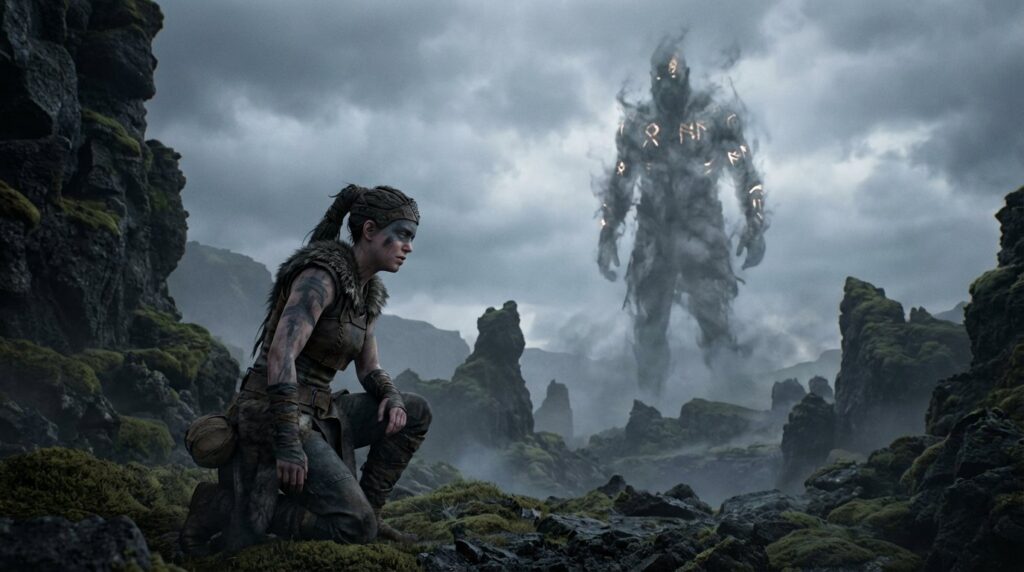
Iceland’s mythic landscapes are brought to life with a painterly, almost hyperreal aesthetic. Mist shrouds ancient ruins, auroras dance across the night sky, and every blade of grass seems to ripple with meaning. Dynamic weather and time-of-day systems add yet another layer of immersion, transforming environments in ways that impact both gameplay and narrative tone.
Performance is generally impeccable, with only minor dips during the most visually intense sequences. On supported hardware, ray tracing and advanced HDR combine to create some of the most striking vistas in gaming—a feat that will likely be referenced for years to come when discussing the visual potential of interactive media in the mid-2020s.
Soundtrack and Audio Design
Audio has always been central to the Hellblade experience, and the sequel continues this tradition with even greater ambition. The soundtrack, a collaboration between returning composer David García and Icelandic folk musicians, is both haunting and beautiful, blending traditional instruments with unsettling electronic textures. Music swells and recedes in tandem with Senua’s emotional state, amplifying the game’s most harrowing and triumphant moments.
The real star, however, is the binaural audio design. Voices swirl around the player’s head, sometimes comforting, sometimes menacing, always immersing. Environmental sounds—wind, water, the distant clash of swords—are rendered with such clarity and precision that they become a crucial part of the narrative fabric. For those playing with headphones, the experience is nothing short of transformative, offering a window into Senua’s mind unlike anything else in modern gaming.
Voice acting across the board is exceptional, with Melina Juergens once again delivering a tour-de-force performance as Senua. The supporting cast is equally strong, lending weight and credibility to every conversation and confrontation. In a year already celebrated for its audio achievements, Hellblade II stands out as a masterclass in sonic storytelling.
Conclusion: Should You Play It?
Senua’s Saga: Hellblade II is not just a worthy successor to one of gaming’s most acclaimed narrative adventures—it is a bold evolution that raises the bar for what interactive storytelling can achieve. In a gaming landscape increasingly defined by sprawling open worlds and multiplayer engagement, Ninja Theory has doubled down on intimacy, focus, and emotional resonance.
This is a game that demands to be played with attention and empathy. It is challenging, often unsettling, and at times deeply uncomfortable. But for those willing to walk beside Senua through darkness and myth, Hellblade II offers one of the most affecting and memorable journeys of the decade.
With its unflinching narrative, stunning presentation, and refined mechanics, Senua’s Saga: Hellblade II stands as a touchstone for the medium in 2026. It is a haunting, beautiful, and ultimately hopeful experience—one that every fan of narrative-driven games owes it to themselves to experience.