
The wait is finally over. After nearly two decades since the last mainline entry, “Metroid Prime 4” arrives as one of the most anticipated releases of 2026, thrusting Samus Aran back into the spotlight—and into the hands of a new generation of gamers. This isn’t merely a nostalgic throwback; it’s a bold reimagining that honors the franchise’s legacy while pushing the boundaries of what a first-person adventure can be on next-gen hardware. For fans who have longed for the atmospheric isolation, labyrinthine worlds, and pulse-pounding action that defined the Prime series, “Metroid Prime 4” delivers in spades, yet it’s also a game brimming with new ideas and technological marvels.
In an era defined by sprawling open worlds and live-service behemoths, “Metroid Prime 4” doubles down on what made its predecessors great, but with a modern sensibility. It’s a game that balances exploration with tension, discovery with danger, ensuring that every corridor and cavern is suffused with purpose. Retro Studios’ meticulous attention to detail and willingness to take risks are evident at every turn, making this a landmark entry not just for Metroid, but for the genre at large.
But does Samus’s latest mission justify the years of speculation and expectation? Is “Metroid Prime 4” the evolution the franchise needed, or a relic clinging to past glories? Let’s delve deep into the galaxy-spanning experience that Nintendo and Retro have crafted, and see whether this long-awaited sequel truly brings the heat.
Gameplay: A Return to Form, Elevated
“Metroid Prime 4” stays true to the exploratory, atmospheric gameplay that defined the series, but it’s immediately clear that this is a game designed for 2026, not 2002. The signature blend of first-person shooting, platforming, and puzzle-solving remains, but it’s been refined and expanded in meaningful ways. The controls are tighter and more responsive than ever, with the new hardware allowing for seamless transitions between scanning, combat, and traversal.
Combat feels weighty and impactful, with Samus’s arsenal providing a satisfying sense of progression. The game walks a fine line between empowering the player and preserving that essential vulnerability—every encounter feels like it matters, especially on higher difficulties. Enemy AI is noticeably smarter, adapting to Samus’s tactics and forcing players to think on their feet rather than rely on rote memorization.
Exploration is as rewarding as ever, with interconnected environments that invite—and often demand—thorough investigation. The sense of discovery, that primal urge to poke into every nook and cranny, is alive and well. This isn’t just a checklist of objectives; it’s a living, breathing world that rewards curiosity with meaningful upgrades, lore, and environmental storytelling.
Core Mechanics
The core mechanics of “Metroid Prime 4” are familiar to series veterans, but Retro Studios has taken pains to modernize them without sacrificing their essence. The scan visor returns, but it’s been reworked to integrate more naturally with the flow of gameplay. Scanning now provides dynamic feedback, hinting at environmental hazards, enemy weaknesses, and even branching sidequests, without ever feeling intrusive or obligatory.
Platforming is smoother thanks to a refined physics engine and improved jump controls. The Morph Ball, a series staple, is more versatile than ever, with new abilities that expand both combat and navigation. Grapple mechanics have also been expanded, allowing for more creative traversal and even mid-air combat maneuvers. These refinements help ensure that movement never feels like a chore, even in the game’s most labyrinthine environments.
Upgrades and suit abilities remain at the heart of progression, but “Metroid Prime 4” introduces a more streamlined approach to inventory management and ability switching. The heads-up display is sleek and customizable, ensuring that information is always at your fingertips without cluttering the screen. Every new power-up feels impactful, opening up not just new areas, but new ways to interact with the environment.
New Additions and Features
One of the most exciting aspects of “Metroid Prime 4” is how it introduces fresh ideas without diluting the series’ core identity. Chief among these is the new “Quantum Visor,” a device that lets Samus phase between parallel dimensions, revealing hidden paths, enemies, and puzzles. This mechanic fundamentally changes the way players approach exploration and puzzle-solving, and its implementation is both clever and intuitive.
Another standout addition is the adaptive AI system, which ensures that enemy encounters feel unpredictable and challenging. Boss fights, in particular, benefit from this upgrade: patterns change on the fly, and weaknesses are no longer static, requiring players to experiment with their arsenal and remain alert throughout each battle.
For the first time in the Prime series, “Metroid Prime 4” also features a cooperative multiplayer mode, allowing two players to tackle select missions together. While it doesn’t overshadow the core solo experience, it’s a welcome innovation that adds replayability and a new dimension to the classic Metroid formula.
Single-Player Campaign
The single-player campaign remains the heart and soul of “Metroid Prime 4.” Spanning multiple planets and biomes, the campaign is a masterclass in pacing and structure. Each area has a distinct look, feel, and set of challenges, keeping the experience fresh from start to finish. The game deftly balances moments of quiet exploration with intense action, ensuring that the tempo never grows stale.
While the campaign is substantial—clocking in at around 20 to 30 hours for a standard playthrough—there’s plenty of incentive to revisit earlier areas as new abilities are unlocked. The world is densely packed with secrets, upgrades, and optional lore, rewarding players who take the time to stray from the beaten path. Yet, thanks to a refined map system and contextual hints, the game rarely feels obtuse or aimless.
The boss battles are particularly memorable, blending spectacle with strategy. Each encounter is a test of skill, observation, and adaptability, often leveraging both old and new mechanics. Whether you’re facing down a hulking biomechanical horror or navigating a labyrinthine gauntlet, the campaign ensures that victory is always hard-won and deeply satisfying.
Story and Setting
“Metroid Prime 4” picks up the narrative threads left dangling in previous entries, but it charts its own course with a fresh and ambitious story. Samus finds herself drawn into a galactic crisis of unprecedented scale, as a mysterious force threatens not just the Federation, but the very fabric of reality itself. The writing is more nuanced than ever, with a greater emphasis on character development and moral ambiguity.
The game’s lore is delivered organically through environmental storytelling, collectible logs, and the expanded scan system. Longtime fans will appreciate the deep cuts and references, but newcomers are given enough context to jump in without feeling lost. The story deftly balances personal stakes for Samus with the broader fate of the galaxy, making for a journey that is both intimate and epic.
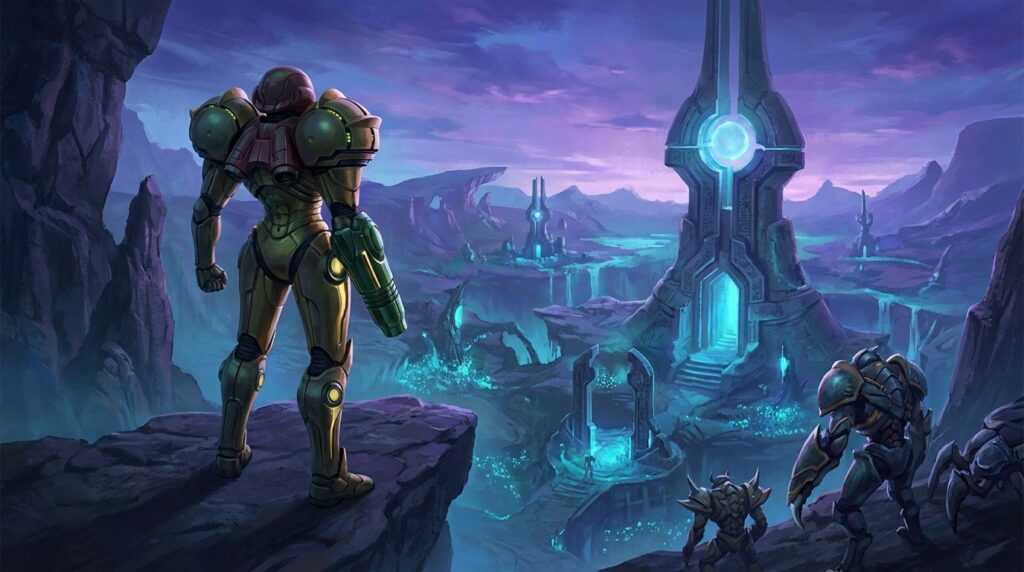
Setting-wise, “Metroid Prime 4” is a tour de force. The game’s worlds are distinct, memorable, and teeming with life—or the haunting absence thereof. From lush, bioluminescent jungles to desolate alien ruins and high-tech space installations, the environments feel meticulously crafted and rich with narrative detail. Each location tells a story, inviting players to piece together the history and fate of forgotten civilizations.
Level Design
The level design in “Metroid Prime 4” is nothing short of exemplary. Retro Studios has perfected the art of interconnected worlds, with sprawling environments that loop back on themselves and reward creative thinking. The sense of scale is palpable, yet the game never sacrifices readability or flow.
Every area is a puzzle unto itself, filled with secrets and shortcuts that only reveal themselves as Samus’s arsenal expands. The new Quantum Visor mechanic adds a layer of depth, allowing players to phase between realities and discover hidden passages or alternate solutions to environmental challenges. This duality not only enhances replayability but also keeps exploration feeling fresh and surprising.
Crucially, the game avoids the pitfalls of backtracking fatigue thanks to smart fast-travel options and dynamic environmental changes. Areas evolve as the story progresses, with new threats and pathways emerging, ensuring that returning to previous zones always offers something new to discover.
Multiplayer and Online Experience
“Metroid Prime 4” marks the series’ most ambitious foray into multiplayer yet. In addition to the aforementioned co-op missions, the game offers a suite of competitive modes that blend the franchise’s signature tension with fast-paced action. Classic deathmatch and objective-based modes are present, but the real standout is “Hunter’s Gauntlet,” a mode that tasks players with racing through procedurally generated levels while outwitting both AI foes and each other.
Online connectivity is rock-solid, thanks to Nintendo’s revitalized network infrastructure in 2026. Matchmaking is quick and fair, lag is virtually nonexistent, and a robust suite of social features makes teaming up with friends or strangers a breeze. While multiplayer doesn’t eclipse the single-player experience, it’s a robust and thoughtfully integrated addition that extends the game’s longevity.
The community is already thriving, with regular events and seasonal updates promised by Retro Studios. Customization options for both Samus and the game’s new cast of bounty hunters add a layer of personalization and encourage long-term engagement.
Graphics and Visuals
Visually, “Metroid Prime 4” is a showpiece for next-gen Nintendo hardware. The environments are a marvel of design and technology, boasting hyper-detailed textures, dynamic lighting, and particle effects that breathe life into every corner of the galaxy. The Quantum Visor’s reality-shifting effects are particularly impressive, seamlessly blending two worlds in real time without a hitch.
Character models—especially Samus herself—are rendered with painstaking detail, from the subtle reflections on her armor to the expressive animations that bring her to life without a word spoken. Enemy designs are imaginative and grotesque, fitting seamlessly into the game’s alien ecosystems.
Performance is consistently smooth, with a stable frame rate and fast loading times, even when rapidly switching between dimensions or engaging in large-scale battles. The art direction is quintessential Metroid: moody, evocative, and endlessly atmospheric, reinforcing the sense of isolation and wonder that defines the series.
Soundtrack and Audio Design
No Metroid game would be complete without a memorable soundtrack, and “Metroid Prime 4” delivers in spades. Composer Kenji Yamamoto returns, blending haunting melodies with driving electronic beats and alien soundscapes that perfectly complement each environment. The score shifts seamlessly from tension to tranquility, underscoring the emotional ebb and flow of Samus’s journey.
Sound design is equally outstanding, from the low hum of Samus’s suit to the shriek of alien fauna and the ambient whispers of forgotten ruins. Every audio cue is meticulously placed, providing valuable feedback during exploration and combat. The 3D audio implementation is a revelation, allowing players to pinpoint threats and environmental clues with pinpoint accuracy.
Voice acting, though sparse, is well-executed, with a focus on environmental storytelling and atmospheric immersion over traditional dialogue. The result is an audio landscape that is as integral to the experience as the visuals or gameplay, drawing players deeper into the primeval mystery of the galaxy.
Conclusion: Should You Play It?
“Metroid Prime 4” is more than a triumphant return for Samus Aran—it’s a watershed moment for the series and a high-water mark for first-person adventure games in 2026. Retro Studios has crafted a game that respects its roots while fearlessly embracing innovation, delivering a meticulously designed, visually stunning, and emotionally resonant experience from start to finish.
Whether you’re a lifelong fan or a newcomer to the series, “Metroid Prime 4” stands as one of the definitive games of its generation. It marries the best elements of classic Metroid design with forward-thinking mechanics and next-gen polish, resulting in a journey that is as rewarding as it is unforgettable. In a landscape crowded with sequels and reboots, Samus’s latest adventure shines as a beacon of what thoughtful, ambitious game development can achieve.
If you’ve ever longed to get lost in a world that challenges your mind, tests your reflexes, and keeps you on the edge of your seat, “Metroid Prime 4” is not to be missed. Samus has returned—and the galaxy feels alive with possibility once again.