
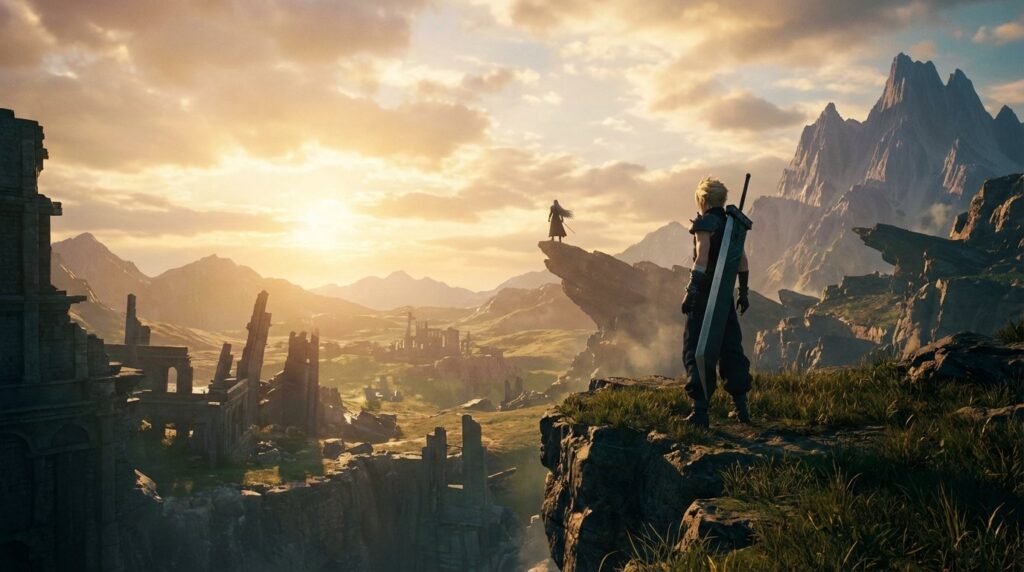
Few games in the history of the medium cast a shadow as long as Final Fantasy VII. The 1997 original didn’t just redefine what a Japanese RPG could be—it redefined what video games could aspire to, period. In 2020, with the release of Final Fantasy VII Remake, Square Enix took the first bold step in reimagining that classic, delivering a modernized, ambitious retelling that, for many, exceeded expectations. Now, in 2026, Final Fantasy VII Rebirth arrives as the highly anticipated continuation in this trilogy. The pressure is immense: not only must it honor its legendary legacy, but it must also innovate in a gaming landscape teeming with narrative-rich, visually spectacular RPGs.
Rebirth isn’t content to simply trace the blueprint of its predecessor. Instead, it confidently stretches beyond nostalgia, blending respectful homage with daring reinvention. This is not merely a remake; it’s a reimagining that challenges both returning fans and newcomers to see Cloud Strife’s journey with fresh eyes. Square Enix’s vision is audacious, expanding the world, deepening its characters, and introducing new systems that push the boundaries of what an RPG can be in the modern era.
But does this bold approach pay off? That’s the question at the heart of Rebirth. As the dust settles on its sprawling landscapes and the echoes of its iconic soundtrack fade, what emerges is a game that manages to honor its past while forging new paths. With an expanded cast, richer environments, and a host of gameplay improvements, Final Fantasy VII Rebirth stands as a milestone not just for the franchise, but for role-playing games as a whole.
Gameplay: Evolution of a Legend
<img src="https://pressstartgaming.com/images/nano_banana_69c16feb26c76.jpg" alt="Final Fantasy VII Rebirth Review: A Bold New Vision for an RPG Classic gameplay moment” loading=”lazy” />
Final Fantasy VII Rebirth refines the hybrid real-time and command-based combat system introduced in Remake, elevating it to new heights. The transition between tactical menu-driven commands and fluid action feels more seamless than ever. Every encounter brims with kinetic energy, rewarding both strategic planning and on-the-fly improvisation. The introduction of new combat abilities and synergy attacks between party members brings a refreshing dynamism to battles, making each skirmish feel unique and engaging.
The game’s open-world elements have been dramatically expanded, inviting players to explore the vast regions beyond Midgar. Side quests, mini-games, and environmental puzzles pepper the landscape, providing meaningful diversions that enrich the main quest without feeling like mere filler. Square Enix has clearly listened to feedback from Remake, ensuring that pacing and player agency are prioritized throughout the adventure.
What sets Rebirth apart is its ambition in bringing the world of Gaia to life. From chocobo races on sun-drenched plains to tense infiltrations in enemy strongholds, variety is the name of the game. Every system feels interconnected, from character progression to exploration, making each hour spent in-game both rewarding and surprising.
Core Mechanics
At its heart, Rebirth builds upon the real-time action and Active Time Battle (ATB) system, marrying the best aspects of old and new. Players can freely switch between party members mid-combat, each offering distinct play styles and abilities. Tifa’s agility, Barret’s ranged power, and Aerith’s magical prowess all shine within a system that encourages experimentation and synergy.
Materia, the iconic magic and ability system, receives notable enhancements. Materia combinations now yield more nuanced effects, allowing for deeper customization. The expanded skill trees and weapon upgrades further empower players to tailor each character to their preferred playstyle, whether leaning into raw offense, tactical support, or crowd control.
Combat is complemented by out-of-battle mechanics, including a robust crafting system, hunting for rare monsters, and environmental traversal that often leads to hidden secrets. The game deftly balances accessibility for newcomers with the complexity and depth that series veterans crave, ensuring that mastery feels both achievable and rewarding.
New Additions and Features
One of Rebirth’s most lauded innovations is the introduction of “Synergy Abilities”—special team attacks unlocked through party bonds and narrative events. These cinematic moves not only look stunning but demand careful timing and collaboration, adding a layer of strategy to both boss fights and standard encounters. Building relationships between party members now carries tangible mechanical benefits, encouraging players to experiment with different team compositions.
The world map, now fully explorable, is dotted with dynamic events and emergent activities. Chocobo breeding and customization return in a big way, allowing players to tailor their feathery companions for racing, combat, and traversal. Optional dungeons and legendary hunts offer challenging endgame content, while quality-of-life improvements—such as streamlined inventory management and more intuitive fast travel—smooth out the experience.
Perhaps the boldest addition is the “Timeline Divergence” system. At key story junctures, players can make choices that subtly (or overtly) alter the course of events and character relationships. While the main narrative arc remains intact, this system grants a sense of agency and replayability rarely seen in the series, inviting players to shape their own version of Cloud’s odyssey.
Single-Player Campaign
Rebirth’s main campaign is a sprawling epic, clocking in at over 50 hours for a straightforward playthrough, with dozens more for completionists. The game picks up immediately after the events of Remake, with Cloud and his companions leaving Midgar and venturing into the wider world. The pacing is notably improved, balancing high-stakes set pieces with quieter moments of character development and exploration.
Each chapter is meticulously crafted, blending main story objectives with optional activities that feel meaningful rather than obligatory. The campaign’s structure encourages both linear progression and open-ended exploration, allowing players to lose themselves in the world or focus on the urgent pursuit of Sephiroth as they see fit.
What truly elevates the single-player experience is the narrative’s emotional depth. The writers deftly juggle nostalgia with subversion, introducing fresh twists while honoring the beats that longtime fans hold dear. Character arcs are richer and more complex, with side quests that reveal new facets of familiar faces and deepen the bonds between party members.
Story and Setting
Final Fantasy VII Rebirth takes the series’ renowned storytelling to new heights. The narrative remains rooted in the struggle against Shinra and the enigmatic Sephiroth, but it’s the expanded focus on character motivations and relationships that sets this retelling apart. Cloud’s journey from aloof mercenary to reluctant hero is given greater nuance, with his internal conflicts and fractured memories explored in poignant detail.
The game’s world-building is exceptional. The towns, cities, and wilderness of Gaia feel alive, each region steeped in its own history and culture. From the bustling markets of Junon to the tranquil beauty of Cosmo Canyon, every locale tells a story through its inhabitants, architecture, and side activities. The narrative weaves in environmental themes, touching on issues of exploitation and resistance that feel especially resonant in today’s world.
Crucially, Rebirth isn’t afraid to challenge expectations. Plot twists and timeline divergences keep even the most seasoned fans guessing, and the stakes are higher than ever. Square Enix’s willingness to blur the lines between canon and reinterpretation results in a story that is both familiar and thrillingly unpredictable.
Level Design
Rebirth’s level design is a masterclass in balancing linear storytelling with open-world freedom. Major story segments are tightly constructed, guiding players through dramatic set pieces and intricate dungeons that demand thoughtful navigation and puzzle-solving. Yet, at almost any point, players can break away to explore the wilds, uncover secrets, or simply take in the sights.
The environments are thoughtfully interconnected, with shortcuts, hidden paths, and verticality that reward curiosity. Whether scaling the cliffs of Nibelheim or navigating the labyrinthine corridors of a Shinra facility, the sense of place is palpable. Environmental storytelling abounds, with visual cues and incidental dialogue fleshing out the world without the need for exposition dumps.
Side content is integrated organically, rarely pulling the player out of the experience. Optional areas offer meaningful rewards—unique gear, lore-rich encounters, or dramatic mini-bosses—ensuring that exploration feels purposeful. The sheer variety in setting and challenge keeps the journey feeling fresh, even dozens of hours in.
Multiplayer and Online Experience
While Final Fantasy VII Rebirth remains a fundamentally single-player experience, Square Enix has woven in a suite of online features that add depth and community engagement without sacrificing the integrity of the main campaign. Cooperative challenges, accessible via the in-game Gold Saucer, allow players to team up with friends or matchmade allies to tackle difficult combat trials and mini-games, earning exclusive cosmetic rewards and rare items.
The asynchronous online elements are elegantly implemented. For example, players can leave hints for others in challenging puzzle areas or share their chocobo racing records globally, fostering a sense of connection and competition. Seasonal events and time-limited challenges keep engagement high, while leaderboards for mini-games inject a competitive edge for those who crave mastery.
It’s worth noting that all online features are entirely optional. Purists can ignore these elements without missing out on any core content, while those seeking community can dive in for added replayability. The balance is deftly struck, proving that a single-player RPG can benefit from online integration without losing its soul.
Graphics and Visuals
The visual presentation in Rebirth is nothing short of breathtaking. Powered by the latest iteration of Square Enix’s proprietary engine, the game sets a new standard for environmental fidelity and character detail. Whether traversing dense forests, bustling urban centers, or windswept deserts, every location is rendered with a painterly attention to light, weather, and texture.
Character models are expressive and lifelike, with subtle facial animations that convey emotion in even the quietest moments. Costumes and equipment are intricately detailed, and every spell and ability explodes with spectacle during combat. The cinematic flourishes—slow-motion dodges, particle effects, dynamic camera work—elevate even routine encounters into visual feasts.
On next-generation hardware, load times are virtually nonexistent, and performance is rock-solid. The game supports both a high-fidelity mode for visual purists and a performance mode targeting a smooth 60 frames per second, ensuring players can prioritize their preferred experience. Accessibility features, including scalable UI and colorblind options, further broaden the game’s appeal.
Soundtrack and Audio Design
Few game franchises boast a musical legacy as storied as Final Fantasy VII, and Rebirth rises to the challenge with an unforgettable soundtrack. Composer Nobuo Uematsu returns alongside new talent to deliver reimagined classics and original compositions that span the gamut from sweeping orchestral epics to intimate, character-driven themes. Each region, dungeon, and boss encounter is underscored by music that enhances the drama and emotion, sometimes swelling to the forefront, other times fading into atmospheric subtlety.
The audio design is equally impressive. Environmental sounds—rustling leaves, distant machinery, the chatter of townsfolk—create a convincing sense of place. Combat effects are punchy and satisfying, with spells, sword clashes, and monster roars all contributing to the game’s cinematic feel. The voice acting, available in multiple languages, is uniformly excellent, breathing new life into beloved characters.
Special mention must be made of the dynamic scoring system, which adapts to gameplay in real time. Tense exploration seamlessly gives way to bombastic battle themes, and quiet moments are punctuated by gentle melodies that linger long after the credits roll. In a year already packed with standout soundtracks, Rebirth’s audio work stands among the very best.
Conclusion: Should You Play It?
Final Fantasy VII Rebirth is both a celebration of the past and a confident leap into the future. Square Enix has crafted a sequel that honors its roots while daring to innovate, delivering a game that is at once familiar and exhilaratingly new. With its expanded world, refined combat, and emotionally resonant storytelling, Rebirth stands as a towering achievement—not just for fans of the series, but for anyone who loves ambitious, character-driven RPGs.
In a gaming landscape increasingly crowded with open-world adventures and narrative epics, Rebirth manages to carve out its own identity. It’s a game that respects its legendary heritage without being shackled by it, inviting both veterans and newcomers to experience the magic of Gaia anew. Whether you’re here for the nostalgia, the combat, or the sheer spectacle, this is a journey worth taking.
For those wondering if Rebirth lives up to its promise, the answer is a resounding yes. It’s a bold new vision for a classic, and one of the finest RPGs of this generation. Don’t miss it.